For someone who knows zero Spanish (that would be me) where do I begin? How do I introduce this in a way that is applicable and real? The last Spanish I learned was on Sesame Street when Gordon and Maria burned the meaning of “agua” into my adolescent brain.
Most people would agree, especially teachers, that learning young has benefits. And for the most part, I totally agree (hence Gordon and Maria flashback).
So, I decided to begin with the twins. My 7-year-old is in school all day so the twins were the default victims to my Spanish stumbling and butchering-of-the-language experiments. They already knew a few hand signs such as “more”, “milk”, and “all done”. I figured this would be a good place to start – they were actually getting these in 3 languages (English, Sign Language, and Spanish). So, not too shabby a place to begin.
I looked up those three things on Google Translate. Now, I will say that I’m not sure exactly how accurate Google Translate is, but it is what I have at my disposal. I also use the Mama Lingua app, which has some great resources. If I have any huge questions, I do have a friend I can ask. But, for the most part, I try to do things on my own and not bother her too much. I AM a teacher… how hard can it be?
So, I translated those 3 things. That’s it. And I said them all week.
All done? (for one kid) = ¿Terminaste?
All done? (for more than one kid) = ¿Terminase?
Milk? = ¿leche?
More? = ¿Más?
I didn’t even use a complete sentence. I just grappled with a few simple words. (I threw in “Good job!” = “¡Bien hecho!” because I say that a lot too.) That was enough for me.
After I mastered those 3 and I was fairly sure the babies knew what I meant (even though they began giving me strange looks) I needed to figure out what to say next. Again, repetition.
So, I asked myself, “What do I say ALL THE TIME?” I made a list and it looked something like this:
Do you want to eat?
Thank you!
Are you hungry?
Do you want to take a nap?
Let’s take a nap.
Don’t throw it on the floor.
Be gentle.
Do you want to go outside?
Do you want a snack?
Put it on the table.
Let’s go upstairs.
Don’t feed the dog your snack.
Leave it alone. (I’m sure I say this at least ten times a day.)
I began noticing a pattern. I say, “Do you want…?” and “Let’s…” pretty often. Having a gazillion things to do, I picked one. The winner was “Do you want…?” So, I looked it up.
Do you want…? (for a single kid) = ¿Quieres…?
Do you want…? (for more than one kid) = ¿Quieren…?
I would then just say the rest of the question in English.
Quieres/n to go outside?
Quieres/n to eat?
Quieres/n a snack?
Hey, they are babies. This is a one sided conversation and they show ZERO judgement. They want to hug me and feed me crackers that have already been in their mouths no matter what language I speak in. It’s all good.
This also led me to writing my second bilingual book: ¿Qué Quieres Comer? – What Do You Want to Eat?
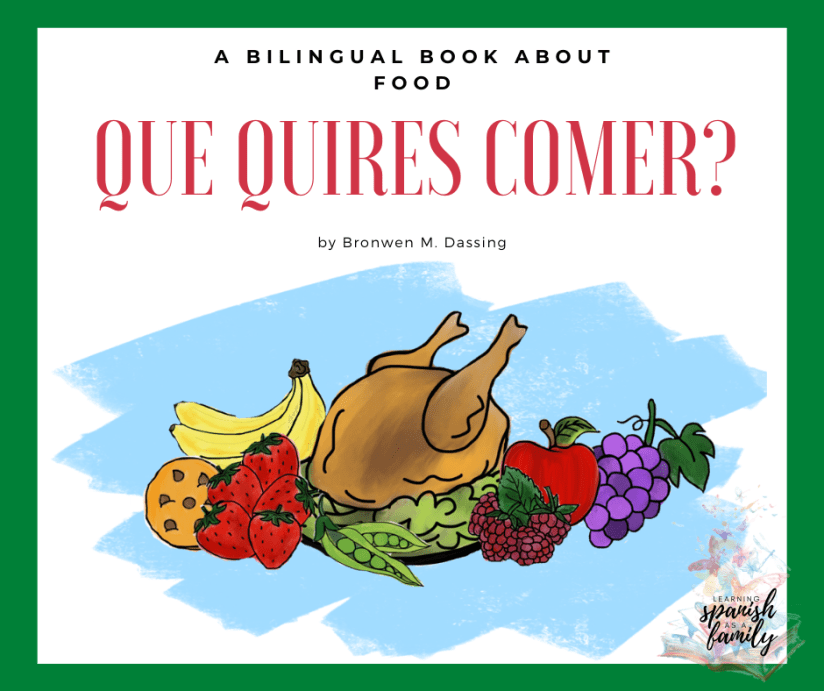
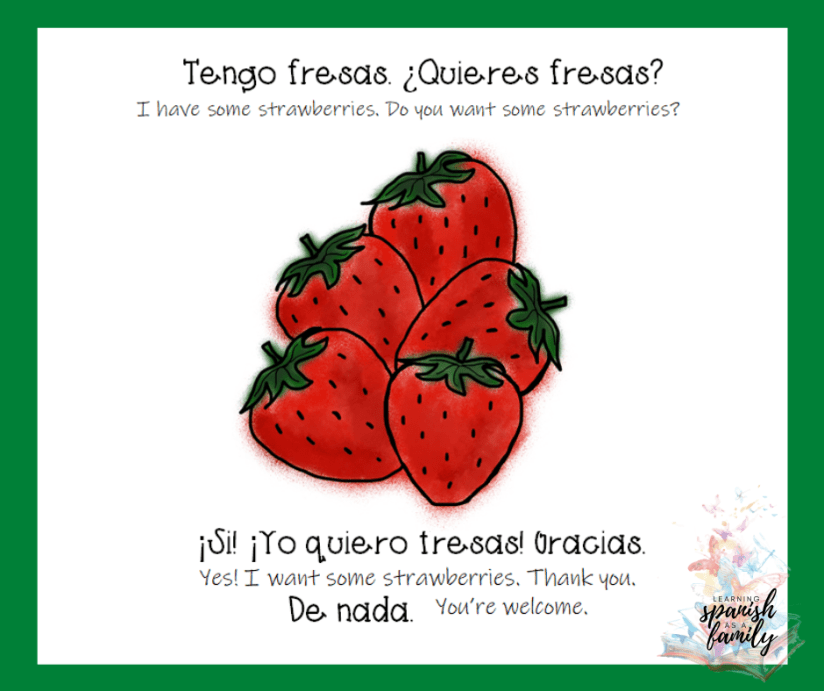
This book focuses on phrases like “I have…” and “Do you want…?”.
And…
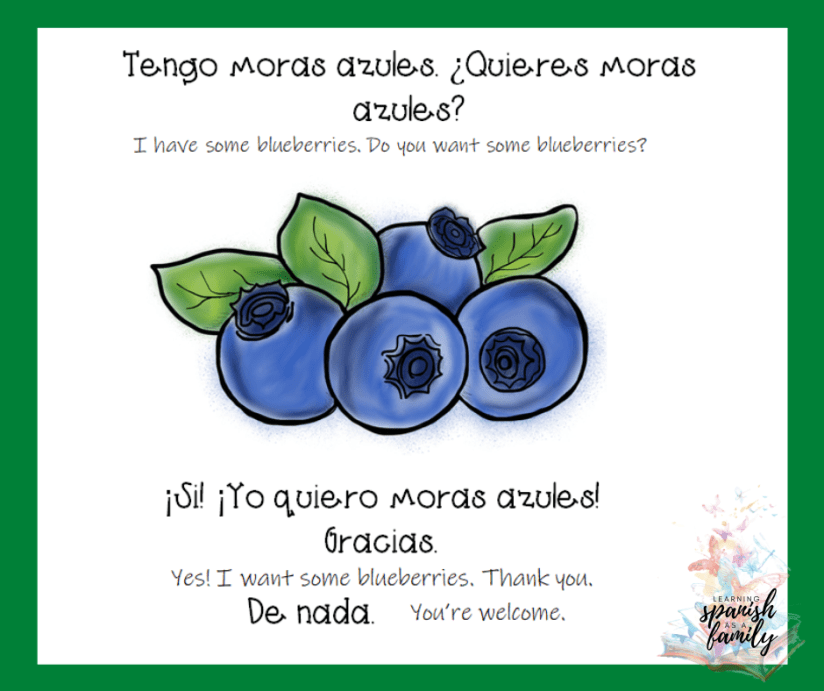
This book was great for my little niños. We would read it, talk about the colors, talk about if they liked the food on it or not… whatever came to mind. It was most helpful for ME because it repeated phrases while only changing a word or two.
Also, I HATE having to look up stuff, especially if I am on the floor playing or in the kitchen with bananas all over me. So, I ordered a decent sized chalkboard and hung it up. Now, I can glance up and have the info right in front of my face.
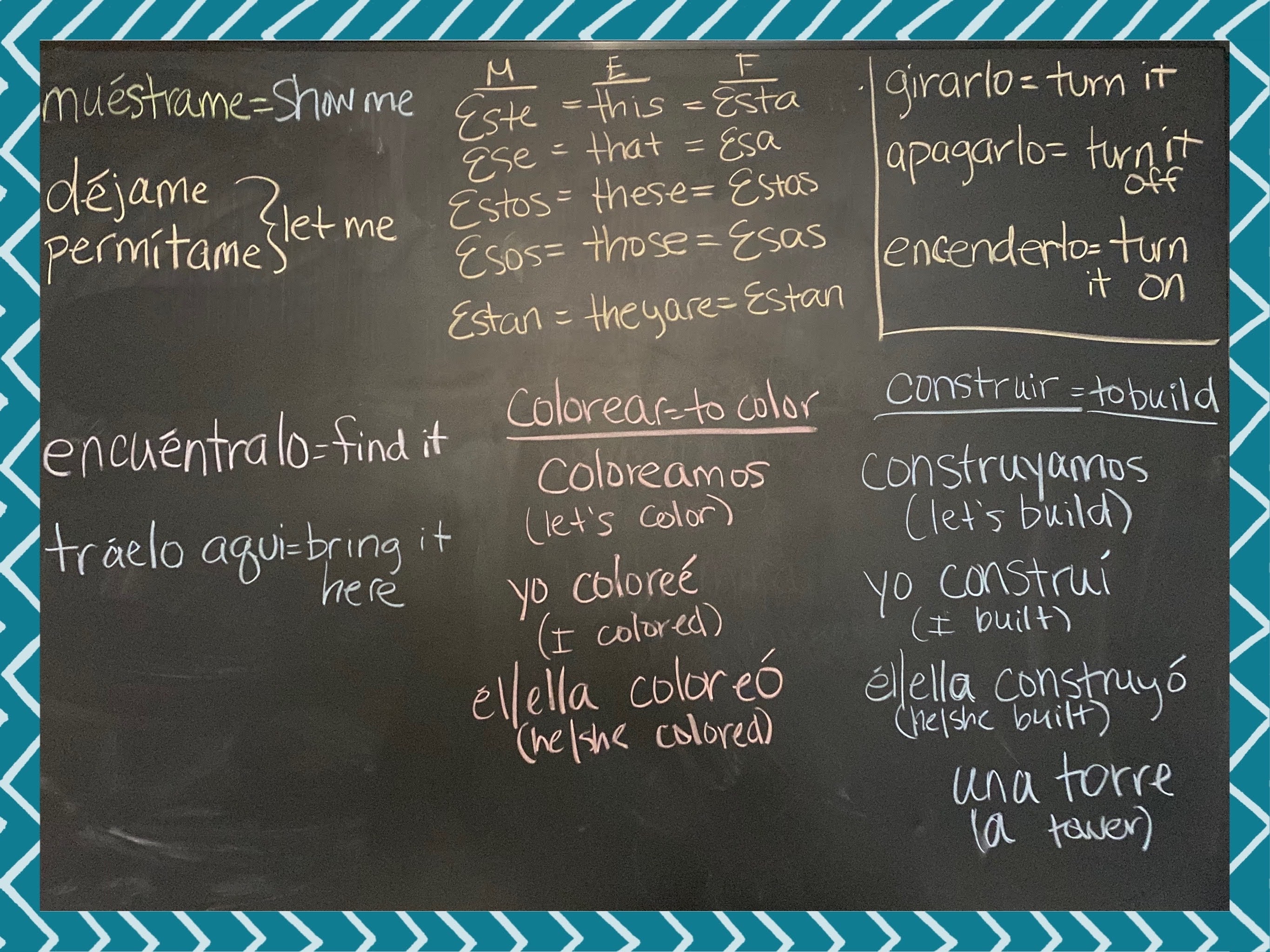
Using the chalkboard is super convenient – I can put things up there that I’m currently learning and erase the ones I’ve learned. I also use different colors of chalk to keep it easy on the eyes (I’m a little crazy like that.)
If you can’t spring for a chalkboard just now, grab some poster board, cardstock, index cards (and put them everywhere). But, leave yourself some room on the poster board so that you can add as you go! Also, make your words large enough that you can read it from across the room. Not all conversations happen in front of the poster, people.
Here is a quick shot of a few index cards I stuck above our changing table upstairs. Can you see why I put those specific words?
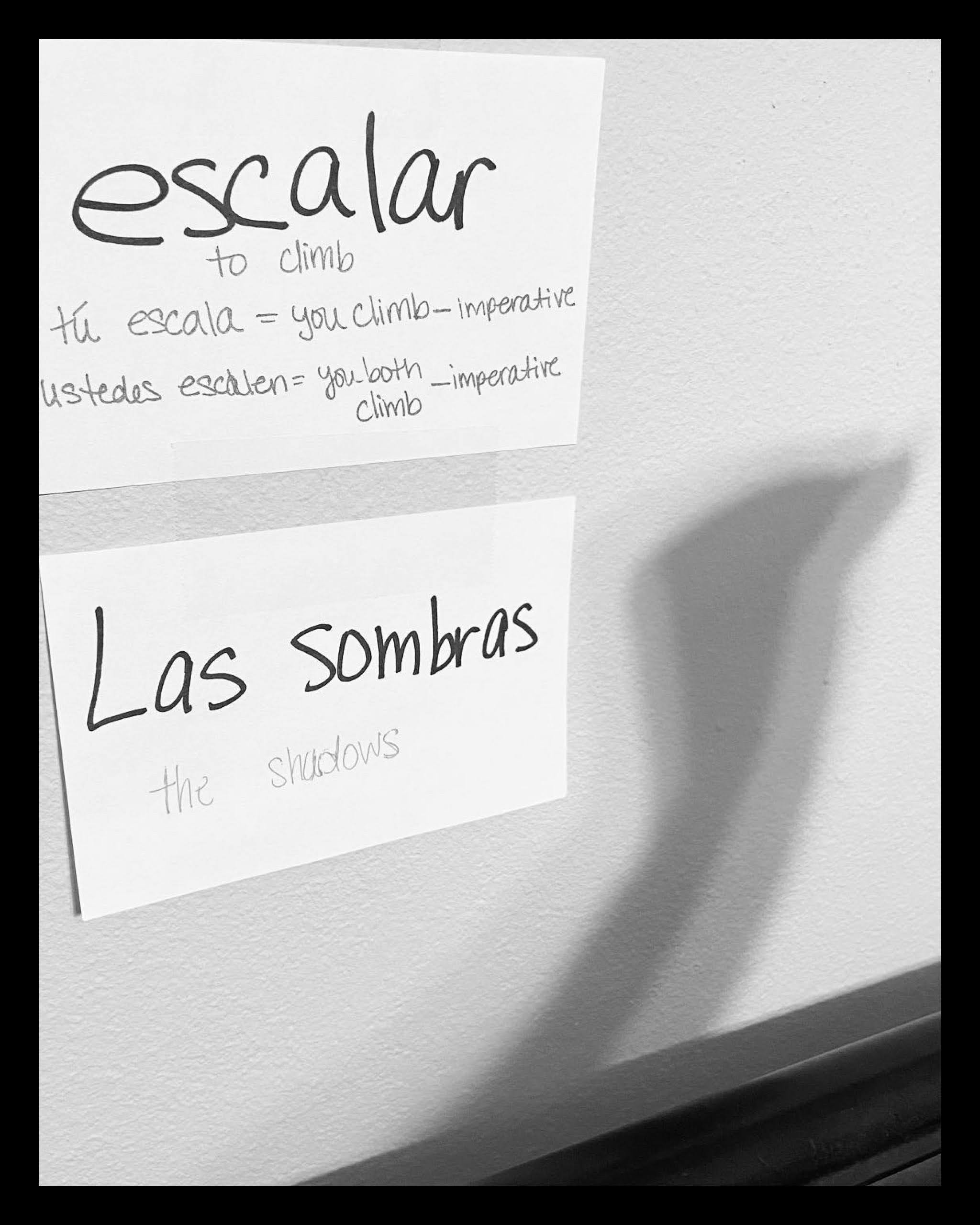
Yep – every time I needed to change a diaper, mis niños would say “shadows, mommy!” Naturally, I needed to extend that vocabulary – after all we were saying it EVERY. TIME.
What do you do when you discover yourself saying things 10 times a day? (C’mon, we just talked about this….)
Here’s another one:
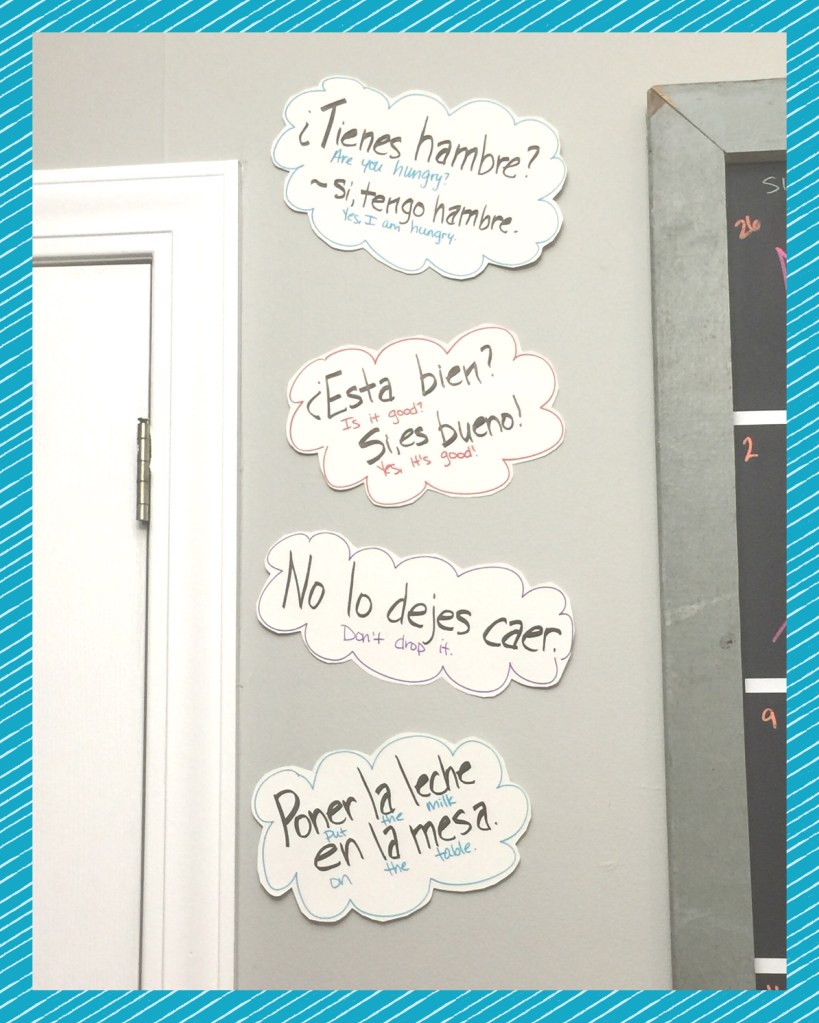
Can you figure out what we say a lot at meal time? Yep. You guessed it.
Now, after I learned these phrases, I took them down to make room for new ones. That’s how it works with phrasal learning.
Which phrases are YOU going to choose to learn this week? Tell me in the comments, follow my blog, or go to my Facebook Page, Group, or Instagram. It doesn’t cost a dime and the rewards you get from learning a new language will be priceless.
Happy Learning! (Feliz Aprendiendo!)
~Bronwen

 Learning Spanish as a Family