If you are like me, you want things to be right the first time. After all, it’s a pain to learn something and then unlearn it, only to have to learn it again the right way.
My music teacher friends are nodding their heads gravely right now.
In my mind, I want to learn it correctly the first time and if I don’t, I’m not doing it at all.
You and I – we need to abandon that thought right now.

How often have you spoken with a person learning English and they say, “I from China.” We all know they are missing the “am” part of this sentence, but do we know what they mean? Of course we do. And we smile encouragingly, excited to know they are learning and continue the conversation as best we can.
It’s okay for us to NOT be perfect when we are learning how to speak a new language.
For me, this is really difficult folks.
I am a perfectionist. I want to know why I change this particular verb a certain way. I want to know so the next time I say something, I can apply the same knowledge. I want to know the pattern. Because there is one, right?
The next time you go to a Mexican joint tell the server – “We are learning Spanish and we are going to do our best to order in Spanish.” Most servers will welcome the experience. They will tell you different ways to say things and nod encouragingly when you get it even partly correct. Especially if you have kids.
This is not an easy thing to do – putting yourself out there with the high possibility that you will embarrass yourself and butcher the language in which you are trying your best to learn. It’s risky. It’s tricky. But – it’s five minutes of your life and you will learn first hand how to do something through a native speaker that is priceless. (And will take you an hour online and you won’t know if it’s even actually correct.)
I’ve had to let this go… and begin to put sentences together even if I’m not sure they are correct. I know how to say certain phrases and I know the names of objects (although I often forget if they are masculine or feminine). I know descriptions go after the noun and not before (la pelota roja- the red ball). And I keep a list of how to say certain things with “it” in them. This is really helpful – I’ve got a list going here. It’s a work in progress, so don’t judge me too harshly.
And now, I’m learning the pattern of how to conjugate verbs… sort of.
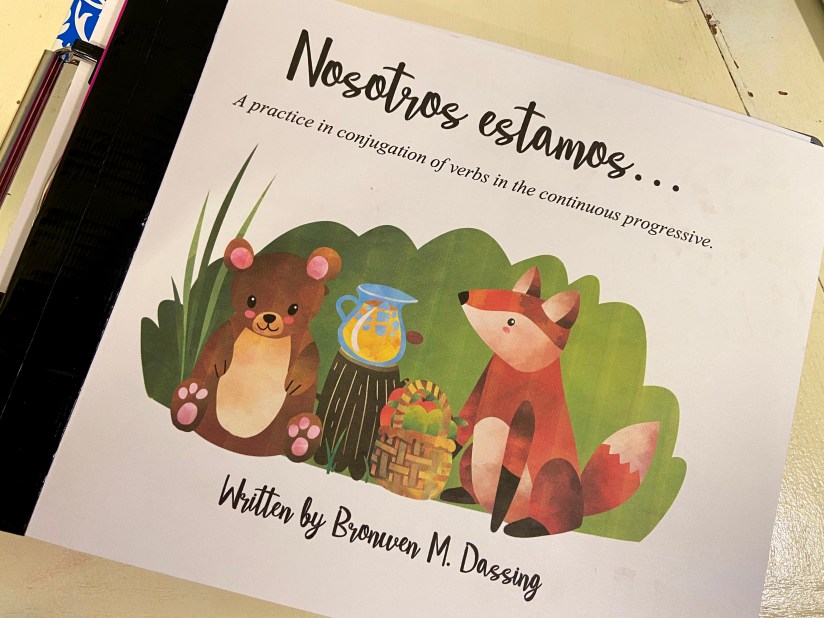
Here’s a book I’m beginning to use like a Bible:


But, I found one problem (so far….🙄)
I wanted to say things to the twins in present tense, as in we are doing something right now. “We are eating”, “We are playing”, “We are leaving”, etc. You might wonder why I would want to say this.

Believe it or not, the twins don’t have a huge attention span and they want to do two things at once. (Whaaaat?!) Being the amazing mom I am, I’m not going to let them play with their toys and eat mashed potatoes at the same time. Hey, I have my limits. Hence, I needed a way to say, “We are eating now, not playing.”
For the life of me, I couldn’t figure out why google translate said it one way, but this book didn’t say it the same.

It’s because I was trying to use something called “present progressive tense”. I don’t really remember the way tenses work in English (harken back to when we had to learn all the parts of a sentence in junior high – who remembers that stuff?) After looking very closely, I found a blurb about present progressive tense at the beginning of the book where it discusses uses of verbs. But, Spanish has about a gazillion tenses and it took me forever to figure this out.
Check it – this is totally cool.
Present progressive tense uses the verb “to be”/”estar” and then you simply add the verb stem with it’s present progressive tense ending FOR ALL SUBJECTS. You can read an article here that blew my mind and made me get an entirely new perspective while speaking to my babes.
Here is a snippet:
Continuous Progressive Formula
estar + continuous participle
Regular continuous participles are formed as follows:
- continuous participle of -ar verbs = verb stem + –ando (Example: hablando)
- continuous participle of -er and -ir verbs = verb stem + -iendo (Examples: escribiendo, comiendo)
My response? A.Maz.Ing.
Let’s do an example: the verb “comer”. It’s an -er verb, so it gets the ending -iendo.
Yo estoy comiendo. = I am eating.
Tú estas comiendo. = You are eating.
El/Ella está comiendo. = He/She is eating.
Nosotros estamos comiendo. = We are eating.
Ellos/Ellas están comiendo. = They(males OR males and females mixed)/They (all females) are eating.

You can remove the subject if you want (I/Yo, You/Tú, etc.) because the estar verb indicates who you are talking about. Not like in English where it’s all the same and you need to say who is doing the action.
How do you practice something like this? Well, believe it or not folks, I wrote a book for this one. (I know… you could see that coming, right?)
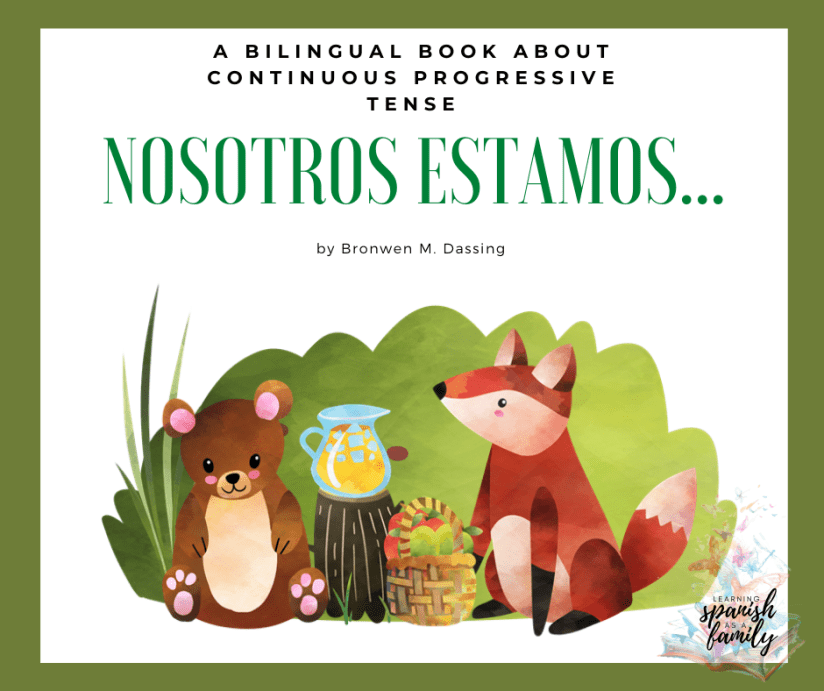
Here is a link to my new book, Nosotros Estamos... It’s a work on the continuous progressive and how to use it. Here is a quick link to how to assemble my books: Free Printables
I write all this to simply encourage you – don’t be afraid to ask for help. Do your research. Go to a local and get their opinions on how to correctly say something (I’m always asking the girls at my chiropractors for advice – and they speak Spanish to the babies. It’s awesome to see how the twins respond to them!)
And don’t feel like it always has to be absolutely correct. You’ll learn what’s right with practice, patience, and a willingness to occasionally not be perfect.
You and your family will benefit from all your hard work. I promise.
Happy Learning! Feliz Apreniendo!
Note: There used to be affiliate links in this blog – there are now NONE. Why? Because I got tired of keeping up with it and really, I just want to help people learn and it makes me happy that you even visited this page. Maybe someday, when I have a TON of time on my hands (which will probably be in about 10 years) I may add affiliate links. But, for now, just enjoy the blog for what it is – a great place to get some FREE stuff, read some FUNNY stuff, and learn some AWESOME stuff. 😘 Chao!

 Learning Spanish as a Family