After describing how I learn and teach my children Spanish, I’ve decided to refer to it as “Phrasal Learning.” Phrasal learning in English usually pertains to a verb with a preposition or adverb that when put together they have a new meaning. I’m using the term to describe learning complete sentences and thoughts in Spanish without necessarily knowing how all the grammar parts work.
Hence – Phrasal Learning! (insert awkward mommy dance here)
Phrasal learning consists of finding a phrase you use every day (a million times a day) and learning how to say it in it’s entirety. The books I write and print for home use (find them here!) has phrases that I say to my littles most often to teach Spanish instead of individual words. Traditional learning teaches you nouns, then verbs, blah blah blah, and then how to create sentences with all that knowledge. I’m not saying it’s bad – in fact, I enjoy all the details and how the grammar puzzle functions. However – when you are learning on the go and have only a few minutes a day to pick something to focus on, the traditional method doesn’t work.
If you check out my earlier posts, I list some of the things I found myself saying at least 10 times an hour to mis hijos. Why not turn that into a dual learning process? Say it in English, then in Spanish. I’m repeating myself anyway, why not do so in a manner that teaches something new? For me and for them.
There aren’t many books (that I’ve found anyway) that use this type of writing. Which is why I ended up making my own.
BUT – I found these little gems at Usborne Books and More Website:


There are two books in this tiny series and they are perfect for little hands. Here is what I did:
I first translated the sentences the book already has (one on each page) to make sure I knew what it was saying. Then, I made a list of questions I would normally ask in English and then translated them to Spanish. Remember, change only ONE thing about the sentence until you are ready for a new phrase.
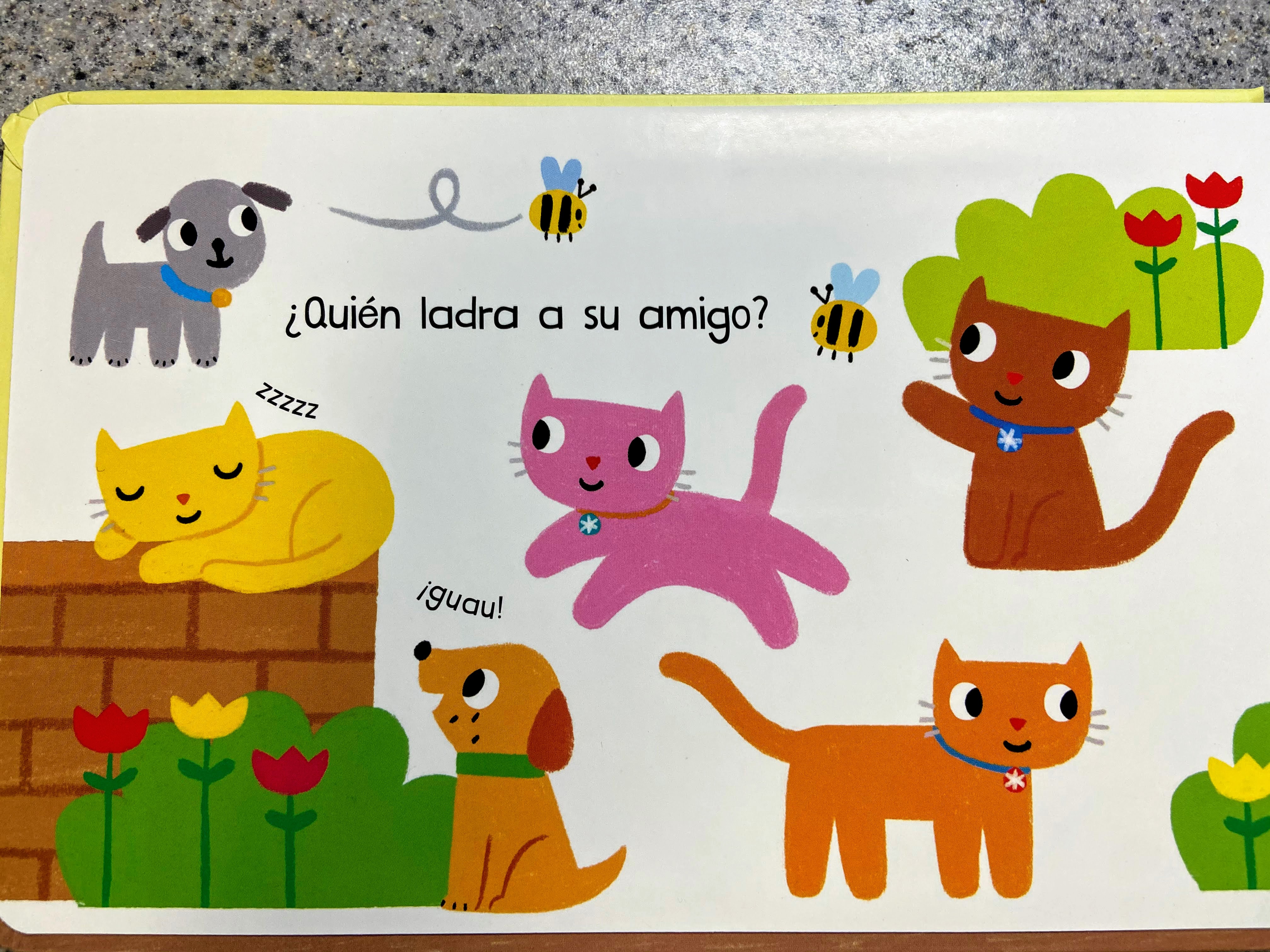
For example, my first set of questions were about the quantity of items on a page.
How many….? (¿Cuantos(m)/Cuantas(f)?)
- bees are there?
- dogs are there?
- flowers are there?
- red flowers are there?
- yellow flowers are there?
- bushes are there?
Then, I make a new line of questioning (totally had a flashback of Austin Powers when I wrote that!)
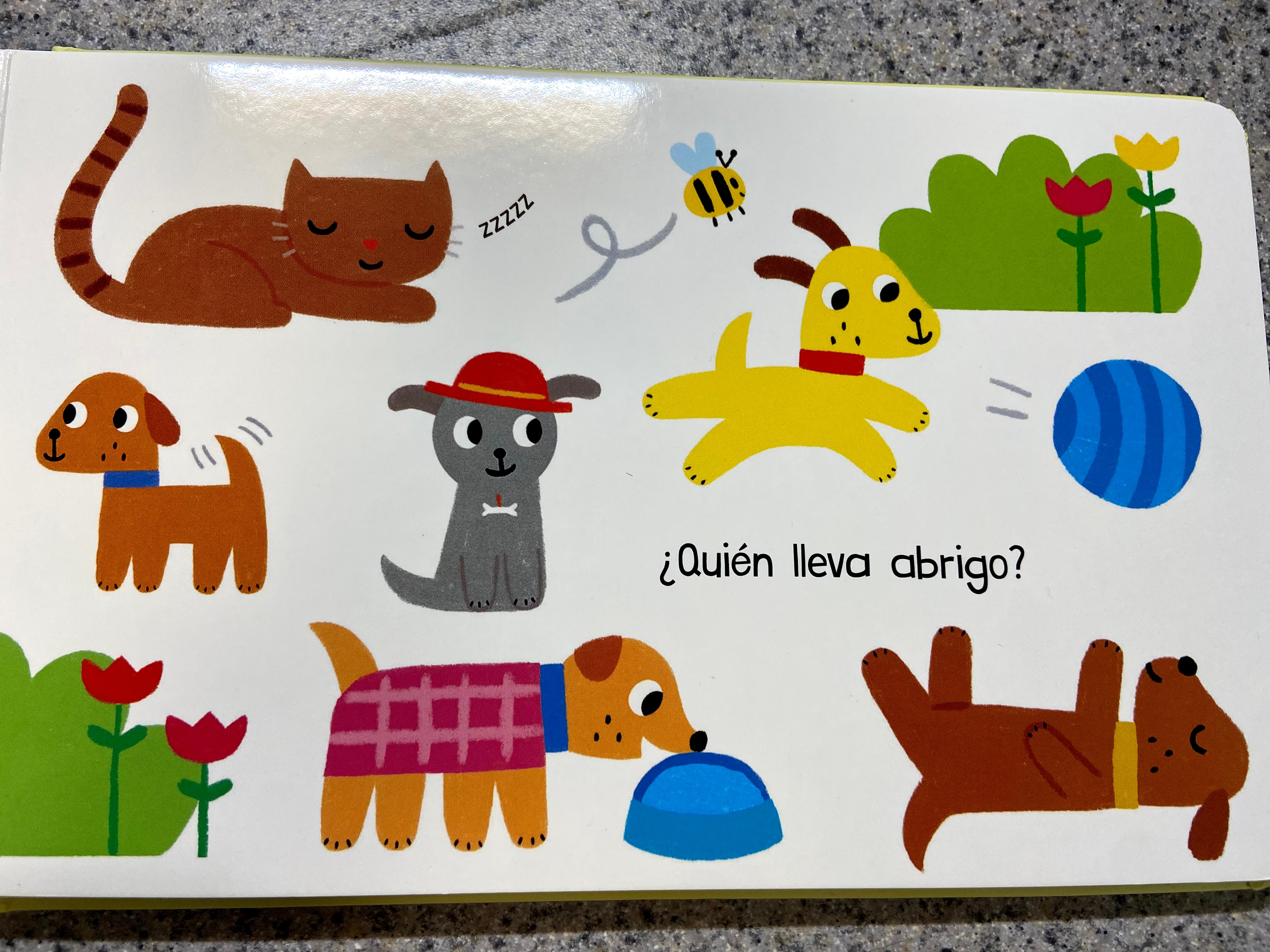
Where is….? (Dónde está…?) NOTE: Where are…? would be Dónde están…? for more than one object.
- the blue ball?
- a sleeping cat?
- the little red hat?
- a bowl of water?
You need MORE??? Of course, you do…
Can you find…? (Puedes encontrar…?) or you could say: Do you see…? which would translate to (Tu) Ves…?
- two sleeping cats?
- a dog wearing a yellow collar?
- a dog wearing a green collar?
- a pink cat?
- a sleeping dog?
If you enjoy doing this with those little books (and want más grande ones!!) Try this series:


You can do the exact same thing! Make a list of questions you would ask in English and then translate to Spanish. Easy peasy…. right?😁
Now, don’t feel you need to rush out and buy these books, although they are pretty great. Look in your own library and find a book with lots of pictures that you can do this with. I encourage you to write in the book, write on a sticky note, write on a blank piece of paper and even TAPE it to the book. It will be so much more available to you if you make it permanent.
I think I’m enjoying this so much, I will make my own set of books with questioning phrases already translated for you. 😊
Hasta la proxima! See you next time!

 Learning Spanish as a Family